
POLYPROPYLENE TRAYS FOR DRYERS
Manufactured by Plastic Fabricators
Drying trays spend a lot of time inside demanding process environments. They may be exposed to heat, chemicals and repeated handling, so the tray material matters just as much as its size.Plastic Fabricators manufactures polypropylene trays specifically for dryer applications. Such trays are produced as a single piece using polypropylene in a molding process, providing them with a robust build without any joints, which might weaken during normal usage. Such trays are capable of withstanding temperatures up to 140°C and are resistant to acids, alkalis, and corrosive substances. In addition, their smooth surface makes them easy to clean, while their non-stick properties prevent product loss during drying and crystallization processes.
The conventional tray has dimensions of 32" × 16" × 1.25", featuring 5 mm thick walls. Specialized sizes may be produced upon request. These trays are used in chemical plants, pharmaceutical manufacturing, API production and dye industries where conventional aluminium or FRP trays may not be the preferred option.
TECHNICAL DATA
WHAT ARE POLYPROPYLENE DRYING TRAYS?
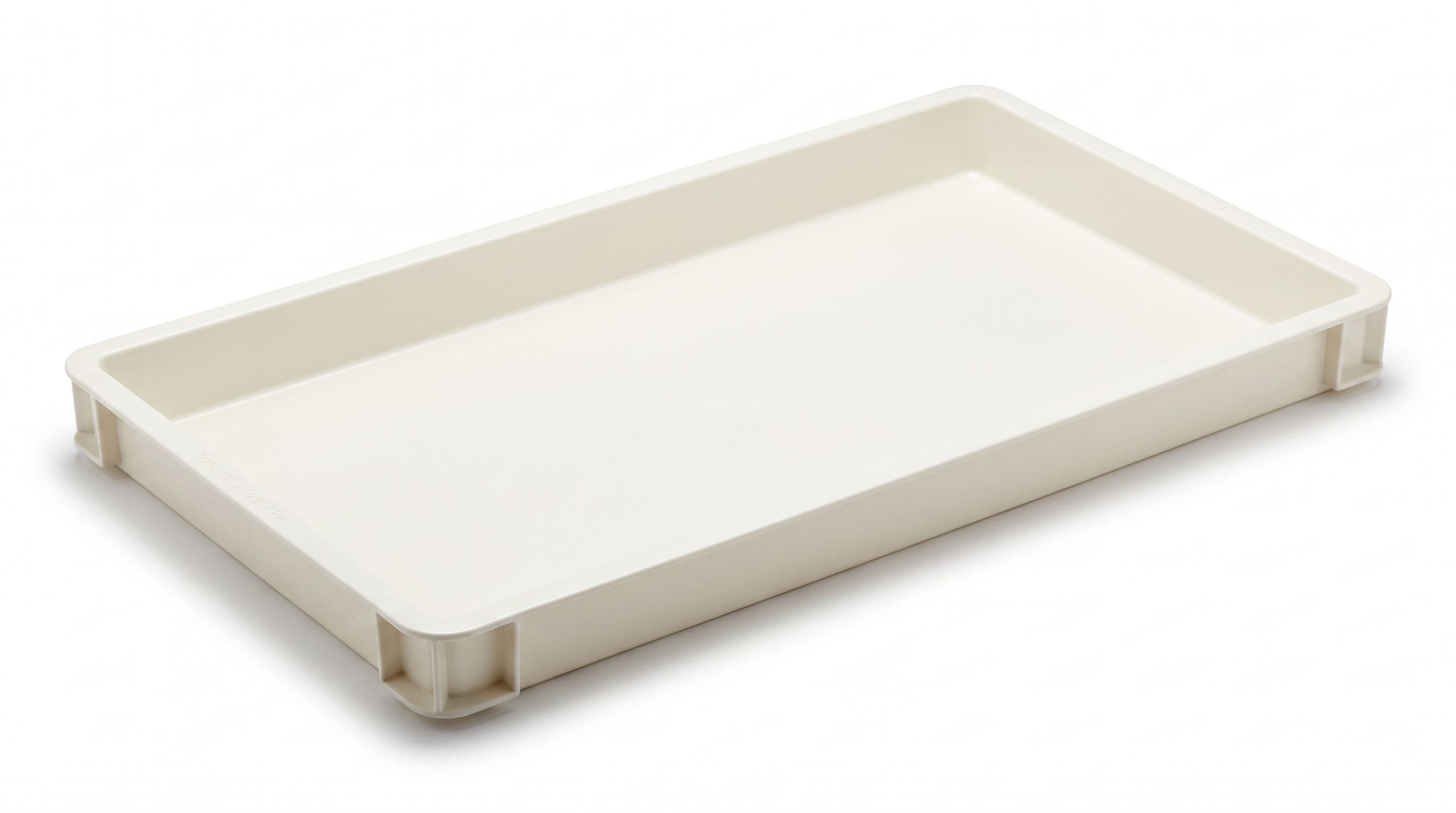
Polypropylene drying trays are used to hold material during drying or crystallisation processes.
Unlike an ordinary plastic tray, a dryer tray has to deal with more than handling and storage. It may be exposed to elevated temperatures, chemical residues and repeated cycles of loading, unloading and cleaning.
These trays are moulded from polypropylene as a single piece. The construction is rigid and designed for regular factory use.
The standard size is 32 inches long, 16 inches wide and 1.25 inches high, with 5 mm thick walls.
One of the practical advantages of the PP surface is that material does not tend to stick as readily to it. That can make unloading easier and helps reduce the amount of product left behind after a drying cycle.
For plants handling corrosive materials, polypropylene also provides resistance to acids, alkalis and other corrosive chemicals.
Why Use PP Trays in Dryers?
COMPLETE PRODUCT RANGE
TYPES OF PRODUCT
When you work with chemicals, you need tools you can count on. That’s why we make our scrapers, spatulas, and scoops from virgin polypropylene they’re built to handle tough jobs without letting you down.
PP GRIDS FOR ROTARY DRUM FILTERS
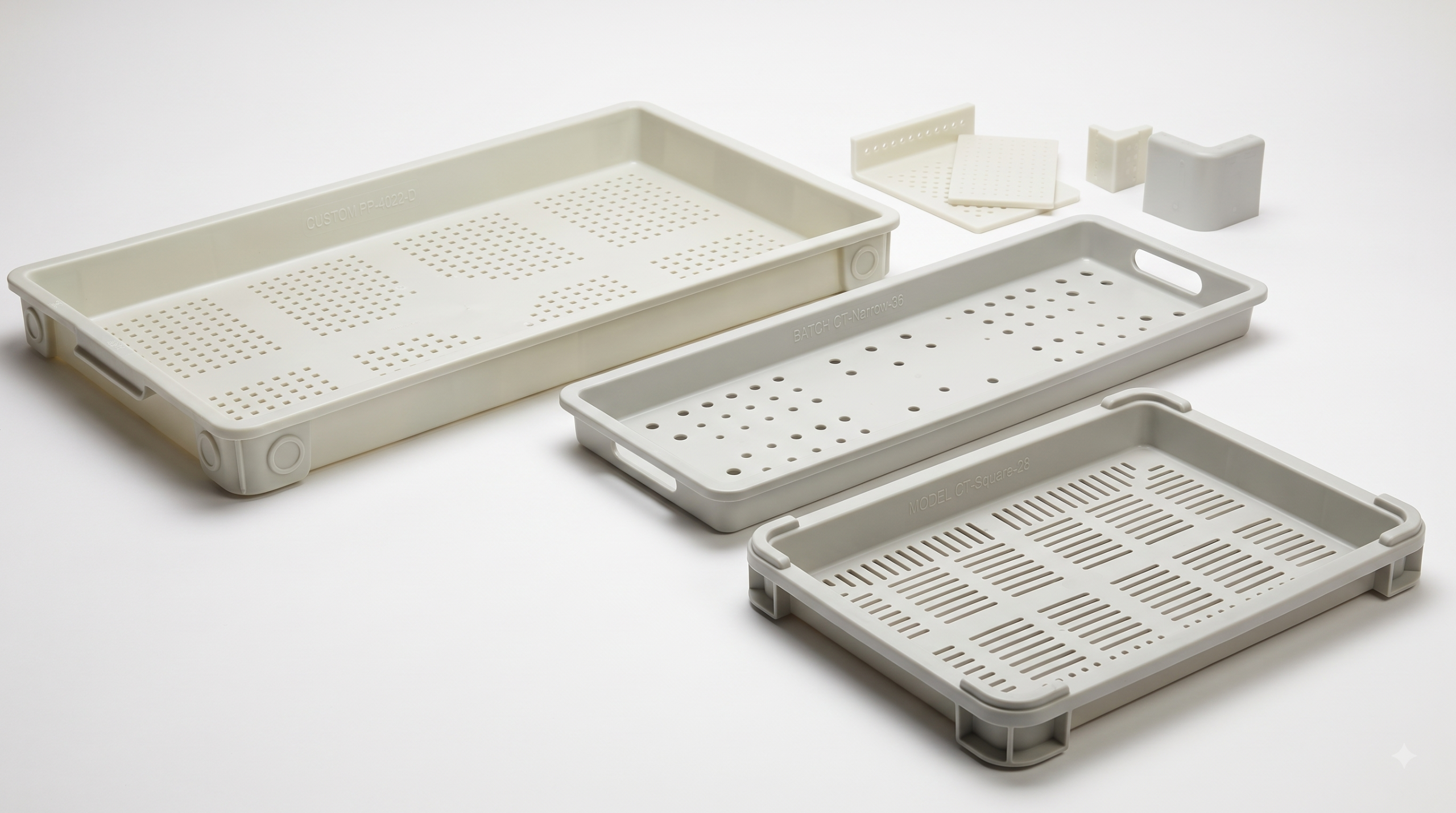
Standard Polypropylene Dryer Trays
Manufactured in the standard size of 32″ × 16″ × 1.25″, these one-piece molded trays are suitable for chemical, pharmaceutical, API, and dye industry applications.
Custom Size Polypropylene Dryer Trays
Manufactured according to customer drawings or required dimensions for dryers that use non-standard tray sizes. Available for bulk orders.
One-Piece Molded Polypropylene Trays
Made using a one-piece molding process to provide a rigid construction without joints, making them suitable for repeated industrial use.
Chemical Resistant Polypropylene Trays
Designed for applications involving acids, alkalis, and corrosive chemicals where polypropylene offers excellent corrosion resistance.
High Temperature Polypropylene Dryer Trays
Designed for drying and crystallization processes operating at temperatures up to 140°C.
Smooth Surface Polypropylene Trays
Manufactured with a smooth finish that helps reduce product sticking and allows easier cleaning after each production cycle.
COMPLETE PRODUCT RANGE
WHERE PP DRYING TRAYS ARE USED?
Typical users include:
- Chemical plants
- Pharmaceutical companies
- API manufacturers
- Dye factories
- Chemical processing units
- Pharmaceutical drying processes
- Industrial crystallisation applications
- Process plants using heated drying equipment
They are especially useful where the tray needs to withstand heat and chemical exposure while remaining practical to clean and reuse.
ORDERING REFERENCE
SPECIFICATION APPROACH
Plastic Fabricators’ standard tray specification is as follows:
| Parameter | Specification |
|---|---|
| Item | Polypropylene Tray for Dryers |
| Material | Polypropylene (PP) |
| Construction Method | One piece moulded |
| Standard Size Length | 32 inches |
| Standard Size Width | 16 inches |
| Standard Size Height | 1.25 inches |
| Wall thickness | 5 mm |
| Temperature Resistance | 140°C |
| Chemical Resistance | Acids, alkali & corrosive chemicals |
| Surface | Smooth and easily cleaned |
| Custom sizes | Available for bulk orders |
TEMPERATURE PERFORMANCE
DESIGNED FOR DRYING PROCESSES UP TO 140°C
Heat is one of the first things to consider when selecting a dryer tray.
The polypropylene trays supplied by Plastic Fabricators are designed to work up to 140°C.
That makes them suitable for a range of industrial drying and crystallization processes where temperature is a regular part of production.
The actual process temperature, duration of exposure and dryer cycle should be considered before finalising the tray. A tray that works for one process may not necessarily be suitable for a different temperature profile.
CHEMICAL RESISTANCE
WHEN THE TRAY COMES INTO CONTACT WITH PROCESS MATERIAL
Chemical plants and pharmaceutical manufacturers often deal with materials that can be hard on conventional tray materials.
PP provides resistance to acids, alkalis and corrosive chemicals.
This is one reason polypropylene trays can be a useful alternative to aluminium or other materials in suitable drying applications.
Chemical compatibility should still be checked against the actual substance being processed, particularly where the concentration, temperature or exposure time is high.
PP VS ALUMINIUM DRYING TRAYS
Aluminium trays have been used in industrial drying for years. But they are not necessarily the best fit for every process.
PP trays offer several practical differences:
- They resist corrosion
● They handle acids and alkalis
● They are suitable for temperatures up to 140°C
● They have a smooth surface
● Product sticking is reduced
● They can be cleaned with water
● They are manufactured as one piece
● Custom sizes can be produced for bulk requirements
The right tray still depends on the dryer, material being processed and operating temperature.
- ✓If the standard 32" × 16" × 1.25" tray does not fit your equipment, custom sizes can be manufactured for bulk orders.
- ✓Dimensions of Dryer interior
- ✓Length of tray required
- ✓Width of tray required
- ✓Height of tray required
- ✓Photograph of existing tray
- ✓Dimensions of existing tray
- ✓Temperature operating
- ✓Material to be dried
- ✓Quantity required
- ✓Photograph / drawing of the existing tray is also helpful in case of a replacement or new manufacturing requirement.
- ✓Before ordering, verify the available space in the dryer.
- ✓Trays should fit well inside the equipment so that the number of trays required can be easily loaded/unloaded inside.
- ✓Dimensions of Dryer
- ✓Loading pattern of trays
- ✓Temperature operating
- ✓Material to be dried
- ✓Exposure to chemicals
- ✓Cleaning process
- ✓Dimension of trays required
- ✓Number of trays required
- ✓In case you are using aluminium/FRP trays now and thinking about switching to PP, it will be helpful if you provide dimensions of existing trays.
TECHNICAL SUPPORT
We Provide Full Technical Support
Our technical team is available to help you select the right profiles, verify load capacities, and confirm chemical compatibility for your specific application.
- ✓Load capacity calculations
- ✓Material selection guidance
- ✓Installation recommendations
- ✓Chemical compatibility data
- ✓Sample profiles for testing (charge applies)
- ✓Project quotations
- ✓Technical questions
- ✓Custom profile development
- ✓Bulk order pricing
CHEMICAL INDUSTRY
A BETTER FIT FOR CORROSIVE PROCESS CONDITIONS
Chemical production often involves acids, alkalis and other corrosive substances.
A tray used in these processes needs to tolerate the material being dried as well as the heat involved in the drying cycle.
Polypropylene offers resistance to these chemical conditions, making PP trays suitable for many chemical drying applications.
The actual chemical should always be checked before selecting the tray material.
PHARMACEUTICAL & API APPLICATIONS
Drying is an important part of many pharmaceutical and API manufacturing processes.
Trays are loaded with material, placed into the dryer, removed after the cycle and then cleaned for reuse.
A nonstick surface of PP simplifies cleaning, while decreased product stickiness helps during the unloading process.
For pharmaceuticals, specific conditions of the process and material handling need to be verified prior to purchasing.
ORDERING INFORMATION
How to Order
Call or message us directly with your requirements. No complex procurement process just tell us what you need, and we will get back to you with pricing and availability. If you are looking for a new or replacement PP grid, send whatever information you have available.
- →Required tray dimensions
- →Custom or standard sized trays
- →Internal dimensions of the dryer
- →Operating temperature
- →Material that needs to be dried
- →Exposure to chemicals, if any
- →Existing tray material
- →Existing tray picture, if available
- →Number of trays required
- →Bulk order requirement, if any
- →Delivery point
- →Timeline
Call or message for pricing, stock availability, technical data sheets, sample requests, and custom quotes.
- 📞+91 98200 80431
- 📞+91 85919 42677
- ✉️mitesh@plasticfabricators.in
- 📍A-31, Second Floor, Ghanshyam Industrial Estate, Veera Desai Road, Andheri (West), Mumbai – 400053
All information accurate as of publication. Specifications subject to change with process improvements. Call to confirm current specifications for your application.
Ready to Order or Quote?
Call or message us directly. We provide load calculations, material selection guidance, chemical compatibility data, and sample profiles.