
FRP PULTRUDED GRATING
Manufactured by Plastic Fabricators
A grating panel has a straight forward job: provide a safe surface for people, equipment, and maintenance access. The difficult part is keeping that surface useful when the site is wet, exposed to chemicals, close to the sea, or difficult to reach. FRP pultruded grating is made for those conditions. It uses fibreglass-reinforced polymer I-beams joined with tie rods to form a strong, open panel. Compared with steel, it is easier to handle, does not rust, and is generally non-conductive.
Plastic Fabricators manufactures and supplies FRP pultruded grating in India for walkways, platforms, access floors, cooling towers, water treatment plants, chemical facilities, solar projects, and custom industrial work.
TECHNICAL DATA
WHAT IS FRP PULTRUDED GRATING?
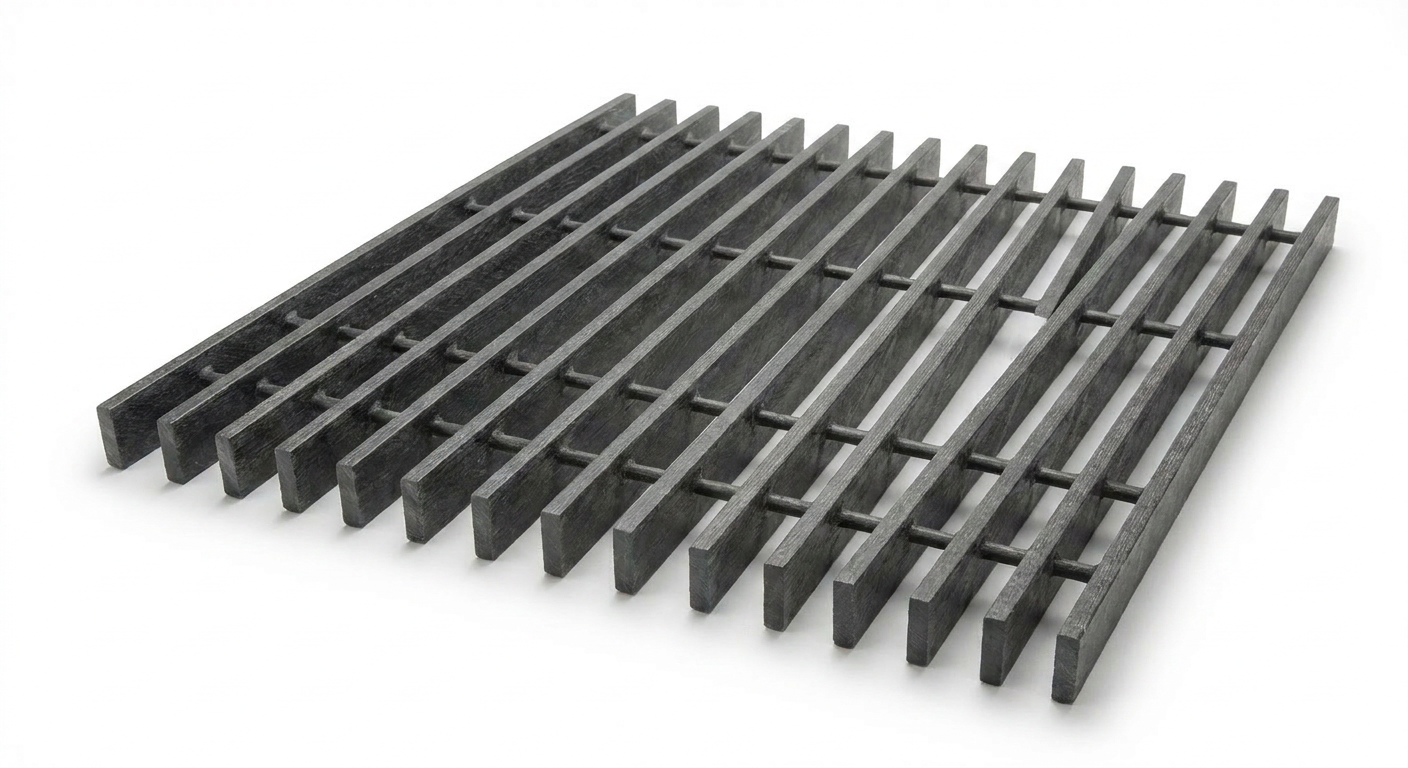
FRP pultruded grating is a load-bearing panel made from fibreglass-reinforced polymer profiles. The main profiles are pultruded FRP I-beams. They are positioned beside one another and attached through transverse tie rods to make an open grid that will be used for pedestrian access, walkways, and industrial flooring purposes.
In pultrusion, the glass fibre passes through the resin and into the heating die, thereby producing a consistent profile. The glass fibre is oriented longitudinally in all the I-beams to give strength to the profile. After the profiles have been cut and assembled, the panels can be installed on the supporting structure.
This is different from moulded FRP grating, which is formed as one interlocked mesh panel. Pultruded grating has a more directional construction, so the main beam direction, clear span, support spacing, and fixing method need to be considered during selection.
In everyday terms, it is a practical replacement for metal grating where rust, weight, electrical conductivity, or regular repainting would create unnecessary problems.
Why FRP Pultruded Grating Makes Sense on Site?
COMPLETE PRODUCT RANGE
TYPES OF PRODUCT
A grating panel is only one part of the floor system. Its performance also depends on the structure beneath it. A panel supported every 500mm is carrying a different demand from one spanning 1,000mm, even if both panels look identical.
The main I-beams should normally run in the direction that gives the most direct support between structural members. Point loads, trolley wheels, equipment legs, and access covers also need to be considered separately from ordinary foot traffic.
For that reason, we recommend sharing a sketch or support detail before selecting a panel solely by thickness or appearance.
FRP GRATING OPTIONS FOR DIFFERENT PROJECTS
FRP Pultruded Grating
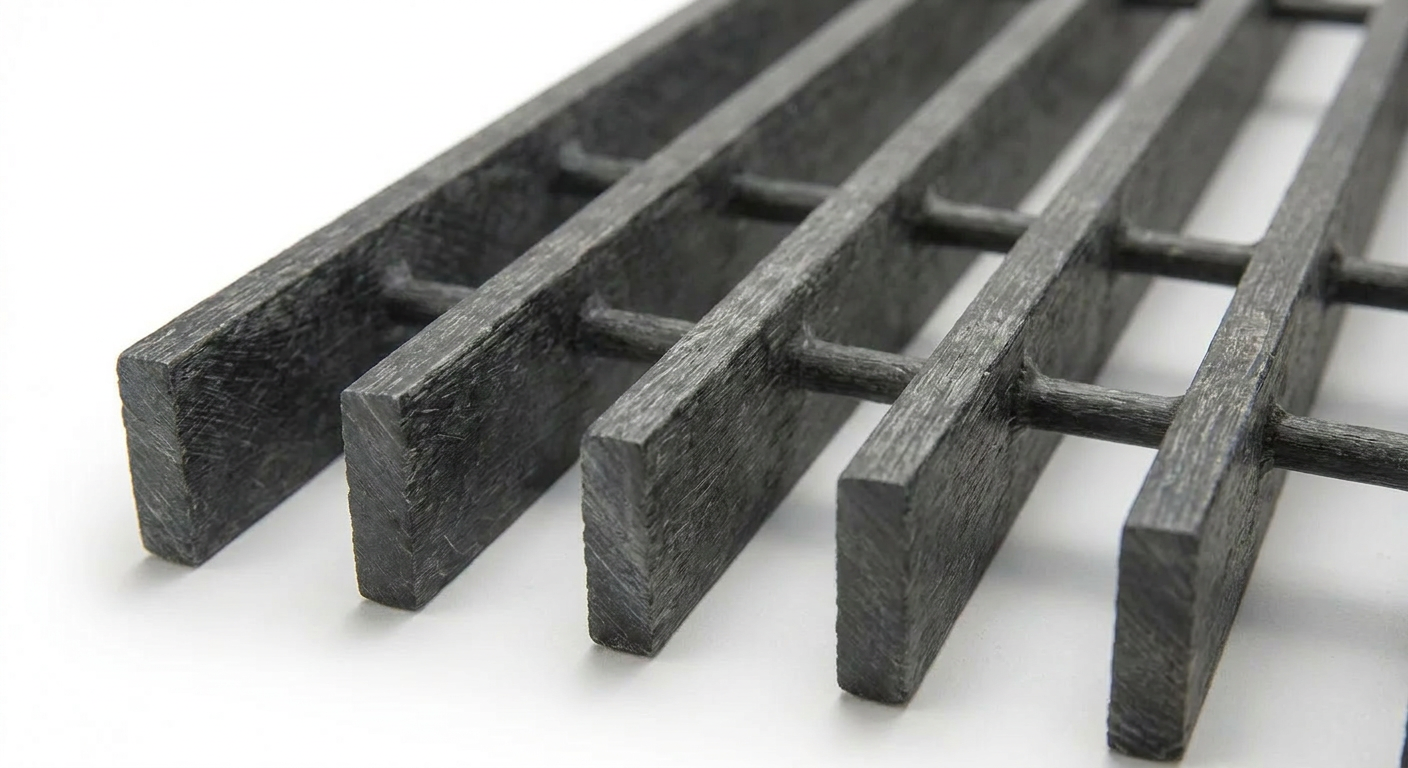
Built from pultruded FRP I-beams and tie rods. It is a strong choice for walkways, platforms, maintenance routes, and other areas where the main load direction is clear.
FRP Moulded Grating
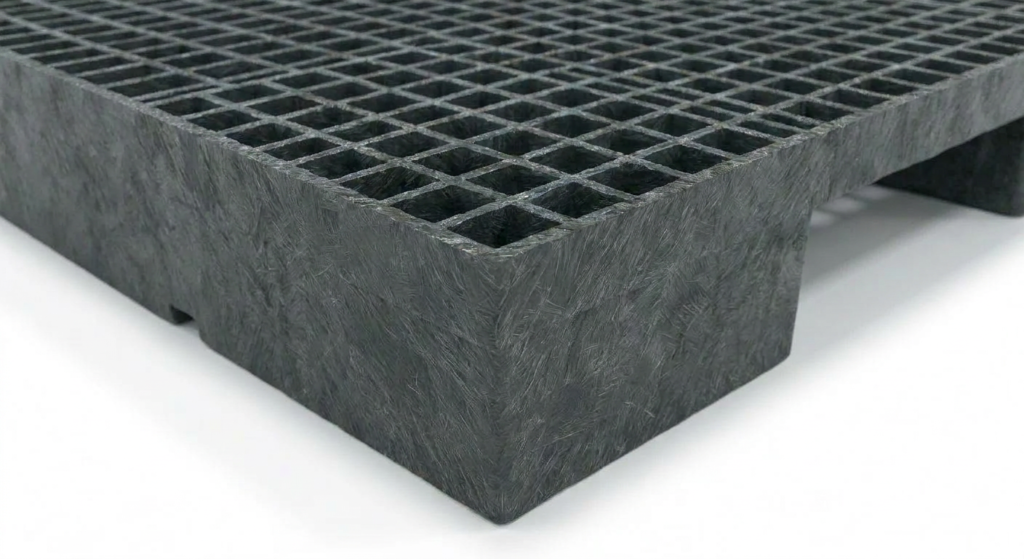
Made as a one-piece interlocked mesh panel. It is commonly selected for general industrial flooring, platforms, trench covers, and locations where a more uniform mesh structure is preferred.
FRP Grating with Chequered Plate
A closed or partly closed walking surface can be used where dropped tools, small parts, or water control are concerns. The exact construction and load performance should be confirmed for the specific panel supplied.
Pultruded Grating
The best option depends on the support arrangement, traffic, chemical exposure, surface requirements, and installation method. Our team can help compare the alternatives before you place an order.
COMPLETE PRODUCT RANGE
WHERE PULTRUDED FRP GRATING IS USED ?
FRP pultruded grating is suitable for:
- Chemical plant walkways and operating platforms
- Water and wastewater treatment facilities
- Cooling tower service decks
- Oil and gas maintenance platforms
- Marine and coastal access structures
- Electrical and utility areas
- Solar farm maintenance walkways
- Industrial stairs, floors, and inspection platforms
- Tank farm access and pipe rack walkways
- Equipment platforms and maintenance corridors
It is particularly useful where the project needs corrosion resistance, lower handling weight, a non-conductive surface, and reduced maintenance.
APPLICATIONS BY INDUSTRY
STANDARD SPECIFICATIONS AND SELECTION NOTES
WHAT DETERMINES THE RIGHT PANEL?
The correct panel is not decided by mesh size alone. The following factors should be reviewed together:
- I-beam depth and profile thickness
- Clear span between supports
- Support spacing and frame arrangement
- Distributed and concentrated loads
- Foot traffic, trolley traffic, or equipment movement
- Panel length and width
- Fixing and hold-down details
- Resin system and chemical exposure
- Surface finish and slip resistance
- Fire, UV, temperature, and electrical requirements
A heavy-duty panel may still need proper support underneath. It should not be treated as a vehicle deck or unsupported floor unless the complete structural design confirms that use.
LIGHTWEIGHT ACCESS AROUND SOLAR PANELS
SOLAR WALKWAY APPLICATIONS
Solar maintenance routes often need to fit between panels, supports, cables, and other equipment. FRP grating is light enough to handle on a large site and can be fabricated into narrower access panels where required.
The walkway width, support spacing, sunlight xposure, surface finish, and cleaning method should be checked before production. For rooftop and solar projects, send a layout or marked photograph so the panel lengths and cut-outs can be planned accurately.
PULTRUDED VS MOULDED GRATING
There is no universal winner. Pultruded grating is often the cleaner choice when the load path is known. Moulded grating may be more convenient where traffic comes from several directions or a one-piece mesh panel is preferred.
CUSTOM FABRICATION
STANDARD PANELS ARE NOT ALWAYS ENOUGH
Industrial openings rarely follow a perfect catalogue size. We can discuss custom fabrication for:
- Exact panel cutting
- Notches around pipes and columns
- Openings for hatches and equipment
- Edge finishing and banding
- Walkway corners and changes in direction
- Custom resin selection
- Grit-coated anti-slip surfaces
- Custom colours where available
A drawing, site measurement, or marked photograph is usually enough to begin. Factory-cut panels reduce site work and help avoid mistakes around pipework and structural members.
TECHNICAL SUPPORT
We Provide Full Technical Support
Our technical team is available to help you select the right profiles, verify load capacities, and confirm chemical compatibility for your specific application.
- ✓Load capacity calculations
- ✓Material selection guidance
- ✓Installation recommendations
- ✓Chemical compatibility data
- ✓Sample profiles for testing (charge applies)
- ✓Project quotations
- ✓Technical questions
- ✓Custom profile development
- ✓Bulk order pricing
ORDERING INFORMATION
How to Order
Call or message us directly with your requirements. No complex procurement process just tell us what you need and we will get back to you with pricing and availability.
- →Application: walkway, platform, floor, trench cover, solar route, or another use
- →Panel length, width, and quantity
- →Clear span and support spacing
- →Expected load and type of traffic
- →Indoor, outdoor, coastal, chemical, wastewater, or electrical exposure
- →Resin or fire-rating requirement, if already specified
- →Surface finish, including grit-coated anti-slip finish
- →Openings, notches, edge details, or access hatches
- →Delivery location and required timeline
Call or message for pricing, stock availability, technical data sheets, sample requests, and custom quotes.
- 📞+91 98200 80431
- 📞+91 85919 42677
- ✉️mitesh@plasticfabricators.in
- 📍A-31, Second Floor, Ghanshyam Industrial Estate, Veera Desai Road, Andheri (West), Mumbai – 400053
All information accurate as of publication. Specifications subject to change with process improvements. Call to confirm current specifications for your application.
Ready to Order or Quote?
Call or message us directly. We provide load calculations, material selection guidance, chemical compatibility data, and sample profiles.