
Which Plastic Material Is Best for Chemical and Corrosion-Resistant Applications?
In industries that consistently face high levels of chemical exposure or corrosion, as well as extreme working conditions, material selection becomes more than critical. Industries that routinely experience this type of environment include chemical manufacturing, wastewater treatment plants, pharmaceutical manufacturing companies, electroplating businesses, food processing companies, and laboratory testing and analysis companies. In these industries, it is essential to use materials that will remain structurally intact during their lifetime, as well as continue to resist corrosion for long periods of time.
Choosing plastic for fabrication is a vital way to achieve what is required by these industries because, unlike many metals, which will continuously rust and corrode from exposure to moisture and air, many types of plastics are inherently isolated from corrosion due to the absence of oxygen and other corrosive chemicals within their structure. However, different varieties of plastic will exhibit the degrees of corrosion resistance depending on the specific chemical(s), temperatures, and operating conditions they are exposed to. This post describes the most effective forms of plastic to utilise in terms of their degree of corrosion resistance for industrial uses, as well as their characteristics, advantages, and how they are used within these industrial applications.
Why Choose Plastics for Chemical and Corrosion Resistance?
While we will discuss various materials later, it is essential to address the reasons for choosing plastics in a corrosive environment.
- Plastics will not rust or oxidise.
- Plastics offer an excellent defence against acid, alkali, salt, and solvent corrosion.
- They are lightweight and can be easily fabricated.
- Plastics require little maintenance and offer a long life span; and
- Plastics are a lower-cost alternative to metal products designed for corrosion resistance.
Based on these benefits, companies operating with aggressive chemicals and high moisture content should consider fabricating their products out of plastic.
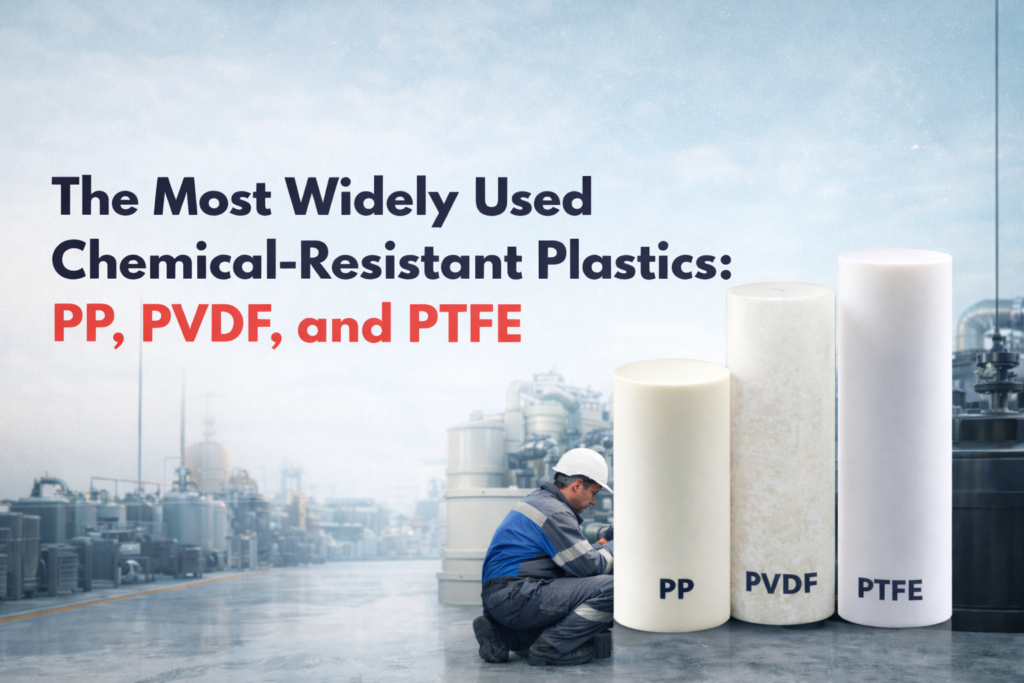
1. Polypropylene (PP) – The Most Widely Used Chemical-Resistant Plastic
Polyvinylpyrrolidone (PVP) represents one of the most common kinds of plastics, due to having high chemical resistance and not being adversely affected by corrosion.
PVP has the following primary features:
- Strong chemical/bio-chemical resistance against alkalis and acids.
- Low density, providing a high strength-to-weight ratio.
- High temperature stability, highly resistant to degradation under high temperatures.
- Options for food-grade and non-toxic versions are available.
Due to the combination of affordability and high degree of chemical protection, PVP makes up the bulk of the market, including chemical tanking, fume scrubbers, ducts, and trays/piping. PVP also has proven resistance to sulphuric acid, hydrochloric acid, Caustic soda, and other common forms of chemical agents. Because of the ease of forming through welding, machining, and thermoforming, PVP can be manufactured to meet specific application requirements.
General applications for PVP include:
- Chemical storage tanks
- Fume scrubber/duct systems
- Pickling tanks
- Pump components and impellers
- Water/wastewater treatment systems
2. Polyvinylidene Fluoride (PVDF) – Premium Chemical Resistance
Polyvinylidene fluoride is a type of specialty plastic that excels in applications that require high strength and durability in aggressive chemical environments.
PVDF is an exceptionally high-performance thermoplastic with many unique qualities:
- Excellent chemical and solvent resistance
- High mechanical strength
- Resists degradation from ultraviolet (UV) radiation and weather
- High purity (low permeability)
PVDF can be used with virtually all types of chemicals, including concentrated acids, oxidizers, and halogens. PVDF maintains its chemical and strength properties when subjected to high temperature, whereas most other “standard” plastic materials have a much lower temperature limit. PVDF is priced at a premium when compared to other plastics, such as polypropylene; however, the benefits of long service and reliability make PVDF
3. Polytetrafluoroethylene (PTFE / Teflon) – Ultimate Chemical Inertness
PTFE has never been outdone regarding chemical resistance.
The key features of PTFE can be summarised as follows;
- Virtually inert to all chemicals
- Suitable for high temperatures
- Low friction
- Non-stick coating
What Makes PTFE the Best Choice?
Because of PTFE’s chemical inertness, it is an ideal choice in very aggressive environments. PTFE’s performance is above the capabilities of other plastics in extreme temperatures and corrosive conditions. Being more expensive than other plastics, PTFE is reserved for applications when no other material will perform satisfactorily.
What Are Typical Applications for PTFE?
Typical usage for PTFE includes linings on chemical tanks, pipe gaskets, seal and valve bearings, and food or pharmaceutical production systems.
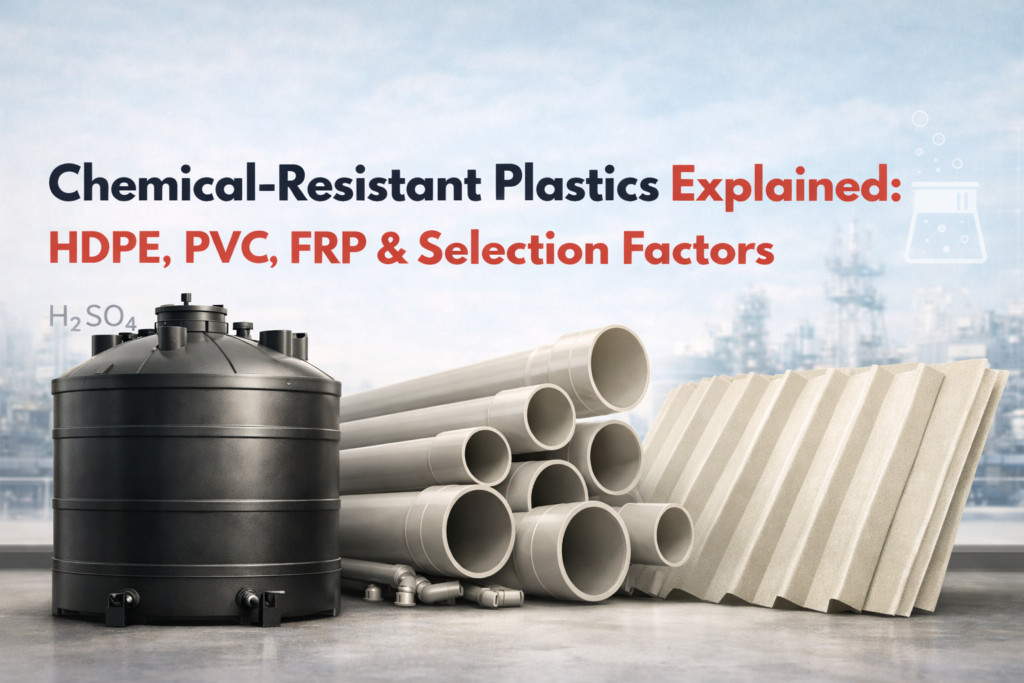
4. High-Density Polyethylene (HDPE) – Tough and Corrosion-Free
HDPE’s chemical resistance and high impact strength make it a popular solution for many applications with these characteristics.
Key Features:
- Water and chemical resistant.
- High Impact and Abrasion Resistant.
- UV-stabilized grades are also available
- Can be Ground and recycled, making them environmentally friendly.
With specific application characteristics:
HDPE has excellent properties for corrosive conditions involving water, salts, and many chemicals; therefore, HDPE is ideal for outdoor applications due to the combination of toughness (impact resistance) and UV-resistant properties. In addition to the properties of HDPE, it is relatively easy to fabricate and weld, making HDPE an excellent choice for large tanks or liners.
Common Applications:
- HDPE Tanks for chemical storage
- HDPE Tanks for water treatment
- HDPE Liners and containers
- Drainage and piped through systems
5. Polyvinyl Chloride (PVC) – Cost-Effective Chemical Resistance
Polyvinyl Chloride is one of the most commonly used plastics that can be used for industrial fabrication and, more importantly, chemical handling. Read on to learn about some of the major properties of PVC, as well as some applications where it can be used.
The major properties of PVC include:
- Excellent Acid and Base Resistance
- Flame Resistant
- Available in Rigid & Flexible Forms
- Inexpensive Compared to Many Other Plastics
PVC is an excellent material for many reasons:
PVC has very good chemical resistance compared to many other engineering plastics at significantly lower costs. However, while it may not withstand extreme temperatures like PVDF or PTFE, it is a good choice for moderate chemical exposure. Additionally, PVC is easy to fabricate and install, which has contributed to its widespread use in duct pipes and duct systems.
Typical Uses for PVC Include:
- Chemical transport systems and piping
- Ductwork for air conditioning, heating, and cooling systems
- Electrical raceways and enclosures
- Storage tanks for low-severity chemicals
6. Fibre Reinforced Plastic (FRP) – Structural Strength with Corrosion Resistance
FRP (Fibre-Reinforced Polymer) materials combine a plastic resin with compatible reinforcement fibres. These fibre-reinforced polymers offer excellent resistance against corrosion and are very lightweight, yet offer very high strength-to-weight ratios. In addition, they are very resistant to environmental and UV damage (sunlight). The manufacturers of fibre-reinforced polymers often design these materials for use within applications that will experience high levels of chemical exposure throughout the life of the product. Therefore, FRP materials are used in many applications within outdoor and industrial environments where long-term service life and low maintenance are required.
Examples of the uses of FRP products may include:
- Chemical tanks and scrubbers
- Gratings and walkways
- Ducts and chimneys
- Industrial benches and covers
7. Key Factors to Consider When Choosing Chemical-Resistant Plastics
When selecting a plastic that withstands chemical exposure, evaluate all chemical components, operating temperature, and required strength. You will want a plastic material that resists corrosion, moisture, and environmental exposure, especially if it is used outdoors or in an industrial application. Also, take into account how easy it is to fabricate the plastic; safety standards, service life. Finally, pick the type of plastic that gives you the right balance of price versus performance for your unique job.
How to Choose the Best Plastic for Chemical Resistance
The following factors influence the selection of appropriate plastics:
- Chemical Type / Concentration
- Heat (Temperature)
- Load (Mechanical Load/Pressure)
- Environmental exposure (Indoor or Outdoor)
- Cost/longevity
PP/PVC works well for mild-moderate chemical exposure situations; however, if the environments include extreme temperatures and or very aggressive chemical exposure, PVDF and PTFE are better materials to use. When building structural components that require durability and can be subjected to either extreme climate conditions (outdoors) or very harsh environments (industrial), FRP and HDPE provide good mechanical and corrosion resistance characteristics.
Plastic vs Metal in Corrosive Environments
Corrosion-resistant plastics have various advantages over metals like Steel or Aluminium, such as:
- No Rusting or Corroding
- No Requirement for Coating
- Reduced Maintenance Costs
- Improved Lifetime Performance in Chemical Conditions
Therefore, when using corrosion-resistant plastic fabrication rather than metal fabrication, you will receive a more efficient and sustainable solution to chemical manufacturing processes.
Conclusion
Plastics offer superior shock, wear, and corrosion resistance over traditional construction materials in terms of durability, maintenance, and cost effectiveness for a wide variety of chemical and corrosion-resistant applications. These plastic materials are available in a number of types, with Polypropylene (PP) still being the dominant plastic due to its excellent chemical resistance and its reasonable price point. For the most extreme use cases, Polyvinylidene Fluoride (PVDF) and Polytetrafluoroethylene (PTFE) provide superior performance but are not cost-effective for most industrial uses. In addition, High-Density Polyethylene (HDPE), Polyvinyl Chloride (PVC), and Fibre Reinforced Plastic (FRP) offer appropriate and reliable solutions to many types of industry that require specific construction materials.
When plastic is appropriately selected for a specific application, safety, long-term reliability, and reduced operating costs will benefit all operations using plastic. As plastic fabricating technologies improve, the ability to utilize highly custom-fabricated, corrosion-resistant solutions in even the most demanding of chemical application environments becomes a reality. When selecting today’s plastic, the probability of fewer failures, lower maintenance costs, and better performance increases significantly.